

How to create a cocktail menu that makes the cash register ring: tricks to increase your profits
It turns out that bars and restaurants often make more profit from their star cocktails than from their dishes, and the industry has taken note. So, welcome to menu engineering! This process involves breaking down the menu items and applying that analysis to design drink menus that drive sales, especially through those more lucrative drinks.
In this guide, you will learn how to examine menus and how to put that analysis into practice in creating your menu. While we will focus on drinks, the principles here are applicable to any respectable menu.
Technical analysis of the menu
Analyzing menu technology is key to bar management. It's a good opportunity to maximize the most common cocktails on the drink menu. In the end, you will identify two things: the most profitable drinks and the most popular ones over a given period. To facilitate this, we recommend using a menu engineering spreadsheet.
Comparison of profitability and popularity
The goal of a bar or restaurant's drink menu is for the most profitable drinks to also be the most popular, and vice versa. If you achieve this, you win! The profitability of a drink depends on its production cost. That is, the amount of product you use, divided by the amount you sell in a given time. First, calculate the cost of each drink on your menu. Keep these numbers handy, as you will need to compare them with the next set of data:
Popularity
The popularity of a drink is easy to measure. Use your bar's POS system or inventory management software to find out how many drinks have been sold during that same period. Now, let's visually represent these two sets of data. Use charts in your spreadsheet. The vertical axis will be the production cost and the horizontal axis, the sales volume. This will show you the relationship between profitability and popularity for each drink. The lower the cost (less expense) and the further to the right on the chart (more sales), the better. Charting will also allow you to:
- Isolate the most profitable drinks. If a drink is expensive and popular, keep it as is! Adjust the prices of beer to align with the best draft beers and watch your profits increase.
- Identify mistakes. Drinks that have a high production cost and little interest from customers should be reconsidered or removed from the menu.
- Find popular drinks that can optimize your profitability. Is there any way to reduce the cost of a drink that is already popular? Changing ingredients, using cheaper spirits, or buying in bulk can help lower costs.
Identify profitable drinks to sell
You can give a boost to drinks that are profitable but not selling well by moving them on the menu, giving them more visibility, changing their name, or redefining them. The idea is to reduce the costs of the best-selling drinks and increase the prestige of the more profitable ones. Once you know which drinks need attention, you can start designing your drink menu.
Design and presentation of the drink menu.
Once you have the numbers clear, it's time to design and present the drink menu. This includes where to place each drink, its visibility, and periodic updates.
Drink Menu Design
Some cocktails can be very profitable, but no one orders them. They may not look good. The way people scan menus is a debated topic. Common wisdom says there is an "optimal point" in the upper right corner where people look first. However, Professor Brian Wansink, author of "Slim by Design," says that menus are typically scanned in a Z pattern, starting from the upper left corner. A study from San Francisco State University also found that diners tend to read menus sequentially, as if they were a book. There is no one way to scan, but each theory has its value and it's worth experimenting to see what works best for your customers. Keep this in mind when trying to highlight your star drink.
Once you consider how your customers' eyes move, think about what they like. Make profitable products appealing. In addition to location, you can add some visual magic to your menu design to draw attention to your star drink. Highlighting an item with boxes, shadows, and borders can work wonders. Imagine a cocktail menu with some well-chosen highlights and other less profitable items relegated to a text section in the bottom right. Another option is to include a photo of the cocktail or some graphic or illustration. Think of the silhouette of a martini glass filled with olives next to a Dirty Martini on the menu, highlighting the charm of martinis.
In addition to visual elements, you can also use verbal elements to make upsells. Highlighting special selections is a good way to add a touch to a profitable product. You just need to add a few words that offer a reason to order that drink. Consider highlighting a drink or a collection of drinks with titles like "Special Selection," "Best Seller," "Seasonal Favorites," "Staff Picks," or "Powerful Potions." Perhaps the last one won't work in every bar, but the idea is for the menu to be varied. People don't usually walk into a bar with just one drink in mind; they come with money and a desire to drink. It would be easier for them if they were told what to order.
Another thing to consider is the studies that have been done about the attention consumers pay to different areas of the menu:
Fixations:
“It shows the visual flow of the consumer when viewing the menu. Where does the eye land first, second, third, etc., and how long does it stay in each place?”
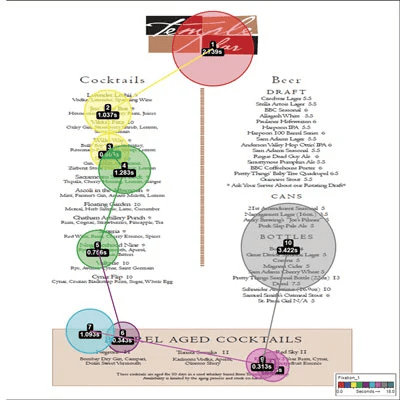
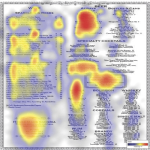
Heat map:
“This is a global view of the visual attention of many consumers viewing the menu. The hot and cold spots demonstrate which areas receive more attention and which are ignored, respectively. It’s a good way to show how design influences the visibility of certain sections of a menu.”
Spotlight:
“This is another view of global attention. It illustrates very well which elements are most considered when the consumer views the menu.”

Seasonal custom drinks are a great example of a special product that sells like hotcakes. This can also apply to other types of menus, such as the table menu, fixed-price menu, or à la carte menu. Think of each season: Stonehenge, Machu Picchu, and successful bars. What do they have in common? They celebrate the change of seasons. One reason to order a drink when you don't know what else to ask for is seasonality. Or even if there were something like a seasonal bar promotion. When a customer walks into a bar and thinks, "I would like a margarita tonight," a good menu should subtly convey that: "There's no rush, it's already autumn." Have you ever thought about apple sangria or a cinnamon tequila sour? Just to be sure, look outside.
Present a list of seasonal flavors and ingredients. This will give people a special feeling as the earth tilts and turns around the sun.
- Spring Cocktails: subtle flavors like apricot, avocado, strawberry, and even celery remind you that life is blooming again.
- Summer Cocktails: with the heat, it's important to cool down. Citrus fruits like pineapple, lemon, and mango, along with cucumber and coconut, are summer staples.
- Autumn Cocktails: soft, sweet, and earthy flavors dominate as the leaves show their true colors. They include apples, pears, ginger, nuts, carrots, blueberries, figs, cinnamon, and pumpkin spices.
- Winter Cocktails: now even sweeter. Warm and inviting flavors like maple, mint, chocolate, and melted marshmallow will warm your heart.
It is advisable to update the drink menu at least four times a year. In addition to seasonal cocktails, there are other items on your menu that benefit from constant review. If you have a digital menu or a QR menu (with a well-placed QR code), updating your menu is very easy. Besides adding or removing seasonal cocktails, this will help you identify which items are more profitable and should be highlighted on your menu. You can also use it to test which visual approach works best to increase sales and which format and text generate more orders.
It is important for your customers to know that you take restaurant hygiene seriously. Single-use menus cannot compete with the update capability of QR menus. In fact, the menu engineering technique consists of updating and analyzing results. If you do not update your menu according to sales patterns, you are missing out on a great opportunity that menu design can offer. That’s why custom QR codes are one of the most valuable elements of technology in restaurants.
Be thorough and descriptive
Drink descriptions are an important touchpoint with customers, and effective descriptions are informative and engaging. Let's look at two examples based on real menus and consider the differences.
- Description 1: Lychee Martini €12. Lychee juice, vodka, vermouth.
- Description 2: Lychee Martini €12. The citrus and rose flavors of lychee characterize this aromatic vodka cocktail tempered with vermouth.
The first explanation is not bad, but if the menu description served any purpose, you probably wouldn't be reading this. Add one or two pleasant adjectives that provide more information about the cocktail and appeal to other senses (like smell or taste). That’s where more people gather, and the cocktail prices can be adjusted to their expectations.
What benefits do digital menus bring to menu design?
The idea behind the development of menus is to continuously respond to data and create profitable menus over time. One of the simplest ways to do this is by using digital menus, especially those with QR codes. QR codes have multiple uses, but one of the best is to offer flexible and instantly editable menus for bars and restaurants. Digital menus with QR codes not only allow for changing menus and prices on the spot without the need to print anything, but they are also hygienic and contactless. They are lighter, more economical, and more convenient than menu apps, and they open up a world of marketing through QR codes. However, when using a free QR code PDF generator, be aware of security risks.
However, high-quality printed menus, with an elegant or attractive design, as well as in innovative formats, capture attention remarkably. These menus are not just a simple informational support, but can become a true business ally that we should not underestimate. Sometimes, it is thought that the digital option is the most suitable, no matter how practical it may be. However, the sensory experience offered by a printed cocktail menu can be irreplaceable, adding additional value to the guests' experience.

This is how menu engineering is done - SUMMARY
? What is Menu Engineering in Mixology?
It is a technique that combines profitability and popularity analysis to optimize which cocktails to include, how to present them, and in what order, with the goal of maximizing sales and profits without affecting the customer experience.
? Key fundamentals
1.Cocktail ranking (we offer you the example of the star-dog matrix):
- Stars: High profitability + high popularity → should stand out.
- Workhorses: Low profitability + high popularity → improve cost or presentation.
- Puzzles: High profitability + low popularity → improve description, placement, or name.
- Dogs: Low profitability + low popularity → eliminate or replace.
2. Strategic menu design:
- Place the most profitable cocktails in the golden zone (top right).
- Use creative or evocative names to generate curiosity.
- Limit options: ideally 4-6 well-selected cocktails per section.
- Apply price anchoring: include one or two premium cocktails to provide context for the average price.
3. Visual psychology:
- Avoid using currency symbols (e.g., "$" or "€") to reduce price sensitivity.
- Use sensory descriptions that trigger desire (e.g., “refreshing citrus explosion”).
- Design by categories (e.g., citrus, smoky, non-alcoholic) or by seasons, to facilitate choice.
? Applied example
| Cocktail | Cost | Price | Popularity | Ranking |
|---|---|---|---|---|
| Craft Margarita | 2 € | 9 € | High | ⭐ Star |
| Classic Negroni | 2.5 € | 10 € | Medium | ? Puzzle |
| Espresso Martini | 3 € | 12 € | High | ? Workhorse |
| Bijou Vintage | 2.5 € | 11 € | Low | ? Dog |
? Ultimate goal
Achieve a cocktail menu that:
- Be profitable for the business.
- Generate an emotional experience for the customer.
- Be in constant adjustment and analysis based on sales and feedback.

Use analysis to design your drink menu and you will become an expert in menu development. Learn to create a menu that satisfies customers, increases profits, and enhances your restaurant's revenue. It takes time and effort to crunch all the numbers, but it's worth it!
"The menu is one of the most important design elements for a bar, as it is the user manual that customers rely on to build their experience."
– Jim Meehan


