

5 keys to improve the operation of your bar
We live in a world of constant change, evolution, and growth. This is also true in the bar world, where new trends, new products, techniques, and service methods emerge. What will never go out of style is professionalism, know-how, and presence. These constant changes force us to stay updated; however, there is a danger of getting lost in the ocean of possibilities if we do not have the basic knowledge and techniques for preparation and service, as well as the essential procedures for the proper functioning of the establishment where we work, from which we begin to grow as professionals, expanding our skills and creative capacity.
In this article, we have summarized for you the 5 basic pillars of successful bar management.
Our goal is to convey key information to help you improve the daily operations of your business.
1. Organization of the space behind the bar.
This must be designed according to the menu and the products to be served. Our movements must be minimized as much as possible - let the hands do more work than the legs!
Throughout our experience of more than 20 years in the Bar Business, this rule has been confirmed time and again: the more we run behind a bar, the less productive we are, we end up more tired, more stressed, and with less cash having served fewer customers, or they have become frustrated waiting so long to receive their first drink that they have given up on ordering the next one...
A good organization of the bar will allow us to increase our performance, improve service, and optimize our profits.
2. Recipe Book
It is essential to have a recipe book for absolutely all the drinks we serve behind the bar, not just for cocktails. Likewise, having the recipe book allows us to create our cost breakdowns for each drink served, which is crucial for inventory control.
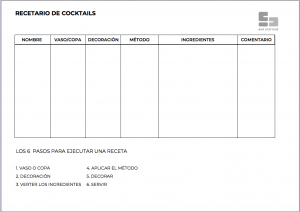
What information should a recipe book provide? A recipe book tells us the ingredients and the amount to serve in the drinks, as well as the order in which they should be added (the order of each ingredient in the recipe is the order in which it is added to the drink).
Here we show you an example of a cocktail recipe book.
3. Techniques for measuring liquids.
This point is one of the most important, as knowing how to correctly use liquid measurements will save us time and money. A lot of money.
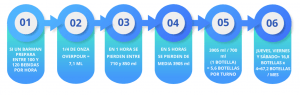
It is essential to respect the established recipes and pour the correct amount of liquid into a glass, which will give us balance among all the ingredients, as that is what makes a great drink. Therefore, the precision with which the ingredients are measured is of utmost importance for the cocktail.
There are three types of correct measurements: with a jigger, using a drink dispenser or pourer, and through free pouring. The bar spoon is also used.
The liquid is measured in milliliters (ml), centiliters (cl), or fluid ounces (oz). In most recipes, we will encounter these measurements.
The professional bartender uses the free pouring method as the primary method for liquid measurements, sometimes assisted by the jigger and the bar spoon.
Free Pouring is a system that allows measuring liquid in its free pour through a simple yet effective way of counting, where the professional controls the exact amount they need to pour. The liquid poured through free pouring is measured in ounces, and is often more accurate than the jigger.
One ounce is equivalent to 0.2957L, which is approximately 30 ml.
It is mandatory to use the jigger when we are not yet experts in Free Pouring. It is highly recommended to do daily training before starting work or during slow service hours, always with bottles filled with water, and checking the accuracy of the liquids using the exact pour.
The exact pour is used to check the accuracy of the pour during Free Pouring training.
In this sense, there are three different states of the pour:
Exact Pour - this is the perfect pour that corresponds to the desired amount, or as its name indicates, the exact pour.
Under Pour - this is the pour that has fallen short of the required amount. It is considered under pour when it deviates by 1/8 oz from the perfect amount.
Over pour - this is the pour that has exceeded the required amount. It is considered over pour when it deviates by 1/8 oz from the perfect amount.
4. Correct mixing method.
Depending on which drink we are preparing, we must use the correct mixing method. By employing precise measuring techniques along with the corresponding mixing method, we ensure the quality of the drink and a standard, as it will be prepared the same way and will always taste the same, even if prepared by different people.
We must know that customers realize that the same drink they usually order tastes different each time depending on who prepared it. They may even choose not to order, order something else, or not stay. to consume if the person preparing the drink is doing it incorrectly. And that is very bad for the establishment's image and its revenue!
Here we detail the 7 basic mixing methods:
1. Build (from English: build) - in this method, the drinks are mixed directly in the glass, over dry ice. It is used when the drinks have a similar density and therefore mix easily. In some cases, it is necessary to stir lightly with the bar spoon, or even with the same straw or stirrer used for serving. Cocktails prepared with this method are characterized by a low percentage of water. Examples: Screwdriver, Cuba Libre, Tequila Sunrise, all alcoholic base and soda drinks.
2. Shake (from English: shake) With the shake method, we achieve a very good mix between the drinks. It is used when we need to mix drinks of different densities, but here the percentage of water is quite higher, and can reach up to 30%. The tool we use for this method is the shaker. To reduce the percentage of water, many times the ingredients are poured first and then filled with dry ice. To achieve a good mix, it is enough to shake vigorously 5-7 times. Then, using the strainer, we strain over the glass filled with dry ice. Carbonated drinks are never shaken in the shaker; they are added at the end. Examples: Sex on the Beach, Mai Tai, Singapore Sling, etc.
3. Stir & Strain. (from English: stir and strain) This mixing method is used when the drinks have a similar density and a high percentage of dilution is unacceptable. The tools we use for this method are the mixing glass, bar spoon, and strainer. The ingredients are poured into the mixing glass in the established order, filled with ice, and then stirred with the bar spoon 7-8 times. The cocktail is served with the help of the strainer (if the recipe indicates double straining - fine strain, with normal and double or fine) in a pre-chilled glass and without ice. This method is used in most cases for short cocktails in the Martini category.
Examples: Dry Martini, Manhattan, Gibson, etc.
4. Blend (from English: blend) - this method achieves the best mix but also the highest percentage of dilution (100% of the ice used). Drinks are prepared in an electric blender, which is the only device capable of perfectly mixing ingredients of different textures such as fruits, ice creams, purees, liqueurs, syrups, etc. All frozen drinks (slushies) are prepared using the blender. Examples: Piña Colada, Frozen Daiquiri, Frozen Margarita
5. Layer (from English: layer) This is a method of pouring drinks in layers, according to their sugar content and alcohol level. No ice is used; the ingredients are poured in order of their density, with the heavier ones at the bottom. The layers are achieved with the help of a bar spoon. Examples: B-52 (shot)
6. Fusion. The classic mixing methods are the 5 previous ones, but in modern mixology, a new mixing method is introduced that we call fusion. This method is a blend of build, shake, stir & strain, blend, and layer.
Mixes made using the fusion method are also those in which we use techniques and tools not common in the 5 classics. An example of this method is the cocktails we prepare using a muddler. Examples: Mojito, Caipirinha, etc.
7. Throwing (from English: throwing). As the name suggests, this method refers to the mixing of cocktails achieved by pouring the ingredients from one container to another (usually shakers), where one of the containers is held as high as possible, and the other - as low. This method is very effective when preparing wine-based drinks, such as vermouth and sherry, as it helps with aeration and releasing aromas. Its purpose is to create fine bubbles of air that add texture in a way that shaking and stirring cannot. With stirring, we won't get bubbles, and with shaking, they would be too large. To appreciate this method, we recommend trying to prepare a Manhattan using the stirring method, and then with throwing, to compare. In Spain, since the 17th century, this method has been used to aerate cider before serving it, from the bottle to the glass, allowing the aromas to be released and enhancing the texture, calling this process the “awakening” of the cider.
The quality of the ice should not be underestimated.
The quality, quantity, and freshness of the ice are essential for preparing a good drink, whether it be a glass or a cocktail. Solid ice of medium or large size behaves better, as it melts more slowly and cools the drink for a longer time.
Normally many establishments have their own ice machine, but depending on the quality of the water, in some places its use is not recommended. Likewise, there are brands on the market, such as Hoshizaki, that have very effective water purification systems, offering optimal ice quality. The most common, although not the most cost-effective in the long run, is for establishments to opt for supply through certified ice manufacturing companies.
This comes in different shapes and sizes: large ice cubes, American ice (small cubes), crushed ice.
Another type of ice is carbonic ice, or dry ice, which is the coldest ice, freezing at -78 ºC. Dry ice is pure and solid carbon dioxide, not suitable for cooling drinks, but excellent for creating "fog" or smoke effects.
When serving ice, we always use tongs or ice scoops, never our hands! Ice is food, so it is extremely important to maintain a high level of hygiene, as there is a risk of contamination from bacteria such as E. coli and streptococcus.
Whenever we serve a drink over ice, we must fill the glass with ice, instead of just putting in a few cubes. This will not only cool the drink more, but it will also make the ice last much longer and not melt quickly in the drink.
The ice we use should be dry, almost sticky to the touch. We must avoid at all costs the "wet" ice that has started to melt.
You should never use the same ice to shake again with the shaker, even if it's to mix the same drink one last time. After straining the drink, you must always discard the used ice. Likewise, it is mandatory to fill the glass with fresh ice before serving the drink inside. Not straining the shaken ice by serving it all together directly into the glass is one of the worst crimes a bartender can commit.
The freezer where we store the ice must be used only for this purpose, and it must be free of odors; otherwise, the ice, being porous, would absorb the smell.
5. Stock and inventory control.
For the proper functioning of the business, we must know how to effectively control our stock fluctuation in order to make correct decisions in managing our bar.
Bar inventory is the only way to ensure that we have control over the liquid assets of the bar, or essentially – over our alcohol stock.
Bar inventory is that essential component, the cornerstone, that allows us to manage a successful bar business.
It is known that it is a tedious process that usually takes quite a long time to do, and for this reason, most people skip it, not to mention that in our country, this practice hardly exists, except in international hotel chains or American franchises. The U.S., the U.K., among others, are countries where the work and inventory control system is highly developed.
Unfortunately, this lack of real control results in an average of 25% losses in the bar industry.
These losses are defined as over-pouring, theft, breakage, spills, etc.
Such losses lead to the bankruptcy of 60-80% of bars in their first 3 years of operation.
Therefore, it is essential to introduce an inventory control system that allows us to effectively manage the amount of alcohol sold, cost price, selling price, and profit margins, as well as order and stock management.
It is essential to respect established recipes and pour the correct amount of liquid into a glass. This is achieved both with the help of jiggers (measuring tools) and through the free pouring system. This is achieved both with the help of jiggers (measuring tools) and through the free pouring system (a method of pouring liquids freely, using special pourers for that system, where the bartender/server controls the amount poured through an internal count). The free pouring system is mastered through initial and ongoing training, as well as daily practice for beginners.
By following these 5 rules, and always recycling and educating yourself, you ensure the successful operation of your bar business.


